
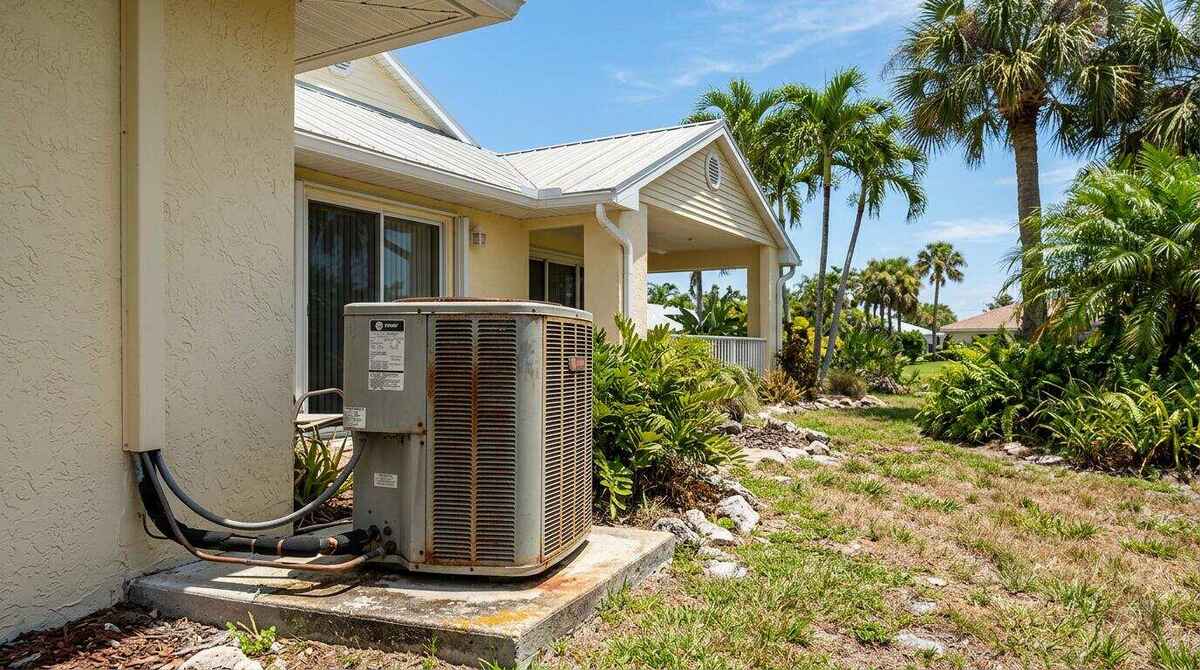
How Long Does an AC Last in Florida?
The honest answer: shorter than the national average, and often shorter than the number on the spec sheet.
You’ll often hear 15 to 20 years quoted as a normal AC lifespan. Florida isn’t normal conditions. A system in Tampa Bay runs far more hours per year than a system in a milder northern climate. Add high humidity, warm overnight lows, salt air in coastal areas, and the kind of heat that doesn’t let up until late October, and you have an environment that wears HVAC equipment down faster than most homeowners expect.
What Realistic Florida Lifespan Actually Looks Like
In Florida, a well-maintained system typically lasts 10 to 15 years. Systems that have been maintained consistently, installed correctly, and not pushed past their capacity tend to stay at the higher end of that range. Systems that have been neglected, oversized, undersized, or running with unresolved issues tend to fall toward the lower end.
Age alone isn’t the whole story. A 10-year-old system with a clean maintenance history, good airflow, and no repair stacking may still have useful years left. A 12-year-old system that has had multiple failures, poor drain maintenance, and a dirty coil may already be past the point where repair makes financial sense.
What Shortens AC Lifespan in Florida
Missing or inconsistent maintenance
Drain line buildup, dirty evaporator coils, and dirty filters are the most common preventable causes of early system failure in Florida. They don’t announce themselves until the system shuts down or the efficiency drops noticeably. Annual maintenance catches these before they become repair calls.
High runtime hours
A Florida system that runs long hours through much of cooling season accumulates more wear per calendar year than a system in a mild climate. More runtime means more mechanical cycles, more electrical wear, and more compressor stress.
Coastal salt air
Homes near Tampa Bay, the Gulf, or coastal inlets deal with salt-air corrosion that attacks coil fins, cabinet surfaces, and contactors faster than inland systems. Protective coatings and more frequent coil maintenance help, but corrosion still adds up.
Unresolved small problems
A slow drain that backs up every summer, a capacitor that is borderline, or a minor refrigerant loss that nobody diagnosed — these problems compound over time and move a system closer to a hard failure sooner than it should arrive.
Poor installation or undersized equipment
A system that was undersized for the home or installed without proper airflow design runs longer than it should to achieve the same result. More runtime accelerates wear everywhere in the mechanical system.
Signs a Florida AC Is Reaching the End of Its Useful Life
These are not guarantees — each situation is worth diagnosing individually — but they are common signals:
- the system is 12 or more years old and performance has visibly declined
- repairs are stacking up: multiple failures within one to two seasons
- the system can no longer keep the house comfortable during peak Florida summer heat
- humidity control has gotten worse — the home feels sticky even when the thermostat says it is cooling
- the outdoor equipment is making sounds it did not make a year ago
- the compressor has already been repaired or replaced once
When to Start the Repair-vs-Replace Conversation
There is no universal formula, but a useful starting point is this: if the estimated repair cost approaches or exceeds half the cost of a new system — and the system is already 10 or more years old — replacement is worth evaluating seriously.
It is also worth thinking about the trajectory. A system that had one repair call two years ago and is now having a second one has a different long-term picture than a system with a clean history that hit a one-time component failure.
Hot 2 Cold also offers flexible financing options for AC replacement if upfront cost is a factor in the decision.
How Maintenance Extends Florida AC Life
The gap between a 10-year-old system and a 15-year-old system is usually maintenance. Annual drain cleaning, coil checks, filter discipline, and catching small electrical wear before it becomes a failure are what separate systems that run to 15 years from ones that get replaced at 10.
Annual tune-ups and routine service are available through our AC maintenance program serving Riverview and the surrounding Tampa Bay area.
Does System Type or Brand Affect How Long a Florida AC Lasts?
System type and equipment tier both factor into how long a Florida AC lasts, though maintenance history still matters more than brand name alone.
Heat pumps vs. straight-cool systems: Nearly all central systems in Tampa Bay are heat pumps because they handle both heating and cooling in Florida’s mild winters. Because a Florida heat pump’s compressor runs in some capacity most of the year, it accumulates more total wear than a system in a seasonal climate — which is why annual service intervals matter more here than a manufacturer’s general recommendation implies.
Variable-speed and two-stage equipment: Higher-tier compressors and air handlers run at lower intensities for longer periods rather than cycling on at full power and off repeatedly. In theory this reduces mechanical stress on each start. In practice the added electronics also introduce more diagnostic complexity — so qualified installation and consistent maintenance matter even more for these systems.
Coastal homes near Tampa Bay: Salt air corrodes outdoor coil fins, electrical contactors, and cabinetry faster on properties within a mile or two of the water. Factory protective coil coatings help, but coastal units typically need shorter service intervals to stay ahead of corrosion-related failures.
SEER rating and lifespan: A higher SEER rating means the system uses less energy per hour of cooling — it does not mean the unit will last longer. A well-maintained budget-tier unit will outlast a neglected premium unit. SEER affects operating cost, not durability.
What Florida’s Year-Round Cooling Season Does to an AC System
In a northern climate with mild summers, a central AC might accumulate 800 to 1,200 hours of runtime per year. In Tampa Bay, that same system sees 2,000 to 2,500 hours annually — more than double the wear per calendar year. That compression of wear is why Florida systems realistically last 10 to 15 years rather than the 15 to 20 years commonly cited in national homeowner advice.
The solution is not to expect less from the equipment — it is to maintain it on a schedule that accounts for Florida’s runtime demands. Annual drain cleaning, coil checks, filter discipline, and catching small electrical wear before it becomes a failure are what separate systems that run to 15 years from ones replaced at 10.
For a full walkthrough of what a Florida AC tune-up covers and why each step matters in this climate, read our Tampa Bay AC tune-up checklist. If you are already seeing signs of decline on an older system, our repair vs. replace guide for Florida homeowners walks through how to frame that decision clearly.
What Does It Cost to Keep Running an Aging Florida AC?
One detail that often gets overlooked in the repair-vs-replace conversation is the ongoing energy cost of an aging, declining system. A system that is running harder than it should to maintain comfort is also drawing more electricity per hour of cooling than a properly functioning or newer unit.
A central AC system that is 12 to 15 years old and has not been recently serviced may be operating well below its rated efficiency. In a Tampa Bay home that runs the AC for 2,000 to 2,500 hours per year, even a 20 to 25 percent efficiency gap adds real money to your annual utility bill. That gap widens further if the system is short cycling, the coil is dirty, or refrigerant charge has drifted.
The calculation is not just repair cost versus replacement cost. It is repair cost plus ongoing operating cost versus the cost of a new, properly sized system that runs at full rated efficiency. For homeowners on the edge of the replace decision, running the full energy-cost comparison alongside the repair estimate often shifts the math toward replacement sooner than the repair cost alone would suggest.
If you want an honest side-by-side look at the numbers for your specific system, our repair vs. replace guide for Florida homeowners walks through the comparison framework in detail.
How long does an AC last in Florida on average?
A well-maintained system typically lasts 10 to 15 years in Florida. Maintenance history, installation quality, and how hard the system has been pushed matter as much as calendar age.
Why does AC not last as long in Florida as in other states?
Florida systems run significantly more hours per year than systems in milder climates. More runtime plus high humidity, salt air in coastal areas, and warm nights combine to accelerate wear.
Can I make my AC last longer in Florida?
Consistent maintenance is the most effective thing a homeowner can do. Annual drain cleaning, filter discipline, coil checks, and catching small problems early can push a system toward the longer end of its expected service range.
My AC is 10 years old. Should I replace it?
Age alone is not enough information. Have a technician evaluate the current condition, repair history, and performance. Many 10-year-old systems still have useful years left. Others are already showing the signs of decline that make replacement the better value.
What is the most common cause of early AC failure in Florida?
Deferred maintenance — particularly missed drain cleaning and dirty coils — is one of the most common preventable causes of early AC failure in Tampa Bay homes.
Why Tampa Bay Homeowners Trust Hot 2 Cold for AC Evaluations
- Licensed and insured — CAC1816786: Florida state HVAC contractor license, verifiable at the DBPR website. You know who you’re dealing with before anyone arrives.
- Serving Tampa Bay since 2013: Over a decade of system evaluations, repairs, and replacements in Riverview, Tampa, Brandon, Apollo Beach, Valrico, and surrounding Hillsborough County communities.
- No-commission technicians: Our technicians earn the same whether you repair, replace, or decide to wait. No financial pressure toward any outcome — the goal is the right call for your situation.
- Diagnosis before options: When we evaluate your system, we document what we find and walk you through the numbers on both sides — current repair cost, replacement cost, and the efficiency gap — before you decide anything.
- Honest lifespan assessments: If your system has useful years remaining, we tell you. If the signs point toward replacement being the better value, we show you the evidence. We don’t benefit more from one answer than the other.
- Same-day service available: When an older Florida system breaks down mid-summer, waiting days for a diagnosis isn’t an option. We dispatch same-day on most calls across Hillsborough County.
Does running my AC 24/7 during Florida’s summer shorten its lifespan?
Running your AC continuously during Tampa Bay’s peak heat months doesn’t inherently shorten lifespan faster than the climate already demands — but it does accelerate component wear. Systems that log 2,000 to 2,500 hours per year accumulate mechanical cycles faster than systems in milder climates. The key variable is maintenance frequency. A system running high hours with clean coils, clear drains, and a tested capacitor handles the load far better than one with the same runtime but deferred maintenance. Florida-grade use demands Florida-grade maintenance frequency — typically an annual tune-up at minimum, twice a year for systems over 10 years old.
Does the R-410A refrigerant phaseout affect how long my existing AC will last?
It affects the repair cost math, which in turn affects when replacing an aging system makes financial sense. As of January 2025, new production of R-410A was banned in the U.S. under the AIM Act. Existing supply can still be used for service and repairs, but prices have risen significantly through 2026. For a Florida system that loses refrigerant due to a slow leak, recharge costs are now meaningfully higher than they were in 2023 or 2024. If you’re already evaluating an aging R-410A system that has lost refrigerant once, this changes the repair-vs-replace equation: the leak will likely recur, and each recharge at 2026 pricing is a stronger argument for replacement than it would have been previously. Ask a technician to walk through the numbers on both sides before committing to another repair.
My AC is 12 years old and ran all summer without a repair call — should I be watching for anything specific heading into August?
A 12-year-old Florida system that has completed a full summer without a failure is in better shape than most at that age — but August is when the cumulative stress of the season shows up. This is the month that borderline capacitors finally fail, drain lines that were partially clear since June fully block, and systems that have been running 16+ hours daily start showing performance gaps that weren’t obvious in June. If the system hasn’t had a tune-up this year, schedule one now rather than waiting for a symptom. A technician can measure capacitor health, refrigerant charge, and compressor amperage draw — all of which degrade gradually and give advance warning before a failure. A 12-year-old system with good maintenance numbers can still have 2–4 years of useful life. One running at the edge of those numbers in August heat is worth evaluating before it makes the decision for you.
Does running my AC continuously during Tampa Bay’s August heat accelerate wear compared to cycling it normally?
Yes, in the sense that more runtime equals more mechanical cycles and more wear per calendar year — but continuous running in August is often necessary and does not by itself shorten the system’s life dramatically if the system is properly maintained. The more accurate way to think about it: a system running 18 hours per day in August with clean coils, a clear drain, and good refrigerant charge handles that load far better than a system running 12 hours per day with a partially clogged drain and a capacitor at 70% of rated capacity. What accelerates wear is sustained high runtime combined with deferred maintenance. August is the stress test. A system that passes it — maintains set temperature, doesn’t short cycle, doesn’t trip breakers — has cleared the hardest month of the year. If it struggles through August without a mechanical failure, schedule a fall tune-up to check what the summer took out of it before heading into the next season.
Not Sure How Much Life Your AC Has Left? Get an Honest Answer
If your system is aging and you want a clear read on where it stands — whether the next step is a repair, a tune-up, or a replacement conversation — schedule a diagnosis with Hot 2 Cold Air Conditioning. We will tell you what we see without pushing you toward a decision that does not make sense for your situation.
Call: (813) 358-4591
Dispatch: 10918 Rodeo Ln, Riverview, FL 33579
Service area: Riverview, Tampa, Brandon, Apollo Beach, Valrico, Fish Hawk, Bloomingdale, and surrounding Hillsborough County communities